The Effect of Starbo AFE and Probio FM Activators on the Physicochemical and Microbial Quality of Gamal Leaf Liquid Organic Fertilizer (Gliricidia sepium)
Abstract
Background: Gamal (Gliricidia sepium) leaves are a nutrient-rich green biomass characterized by high protein and nitrogen contents, making them a promising feedstock for liquid organic fertilizer (LOF) production. However, the quality and stability of LOF largely depend on fermentation efficiency and microbial activity.
Objective: This study investigated the individual and combined effects of Starbo AFE and Probio FM microbial activators on the physicochemical and microbiological properties of G. sepium-based LOF, including color, viscosity, total dissolved solids (TDS), pH, and microbial activity.
Methods: The experiment comprised four treatments: K0 (control, without activators), K1 (100 mL of Starbo AFE), K2 (100 mL of Probio FM), and K3 (50 mL of Starbo AFE combined with 50 mL of Probio FM), with three replicates per treatment. Fermentation was conducted over 30 days, with observations performed on days 0, 15, and 30.
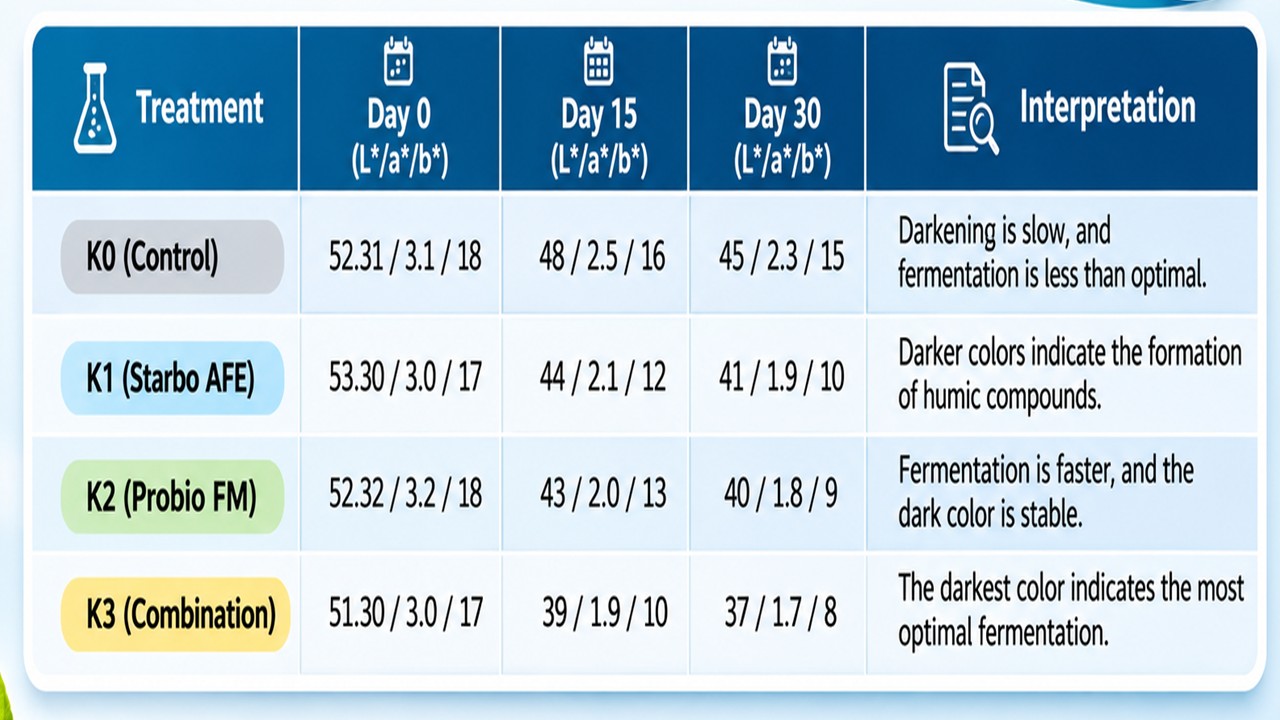
Results: The results demonstrated that microbial activator treatments significantly affected all evaluated parameters (p < 0.05). The combined application of Starbo AFE and Probio FM (K3) resulted in the darkest and most stable coloration, the lowest viscosity, the highest TDS, a stable acidic pH, and the greatest abundance of beneficial bacteria.
Conclusion: These findings suggest that the combined application of Starbo AFE and Probio FM represents a promising strategy for improving the physicochemical and microbiological quality of G. sepium-based LOF, with potential implications for sustainable organic fertilizer production.
Keywords:
Starbo AFE, Probio FM, Gliricidia sepium, liquid organic fertilizer, microbial activity.How to Cite
References
Çetinkol L, Turgut AC. “Effects of liquid organic fertilizer on growth and volatile components of Arugula under salinity.†BioResources. 2024;19(4): 7250. https://doi.org/10.15376/biores.19.4.7250-7278.
Zheng X, Wang MK, Che J, Chen Y, JiangLin L, Wang J, et al. “A novel microbial fertilizer derived from Pennisetum giganteum juice for drip-fertigation of solanaceous fruit vegetables.†Industrial Crops and Products. 2025;235: 121668. https://doi.org/10.1016/j.indcrop.2025.121668.
López-Rubio JF, Cebriánâ€Tarancón C, Alonso GL, Salinas MR, Sánchezâ€Gómez R. “Preparation and Characterization of Liquid Fertilizers Produced by Anaerobic Fermentation.†Agriculture. 2025;15(11): 1225. https://doi.org/10.3390/agriculture15111225.
Phibunwatthanawong T, Riddech N. “Liquid organic fertilizer production for growing vegetables under hydroponic condition. International Journal of Recycling of Organic Waste in Agriculture.†2019;8(4): 369. https://doi.org/10.1007/s40093-019-0257-7.
Tsaniya AR, Dewi EN, Anggo AD. “Characteristics of liquid organic fertilizer from different composition types of seaweed between Gracilaria sp. and Sargassum spâ€. Journal of Physics Conference Series. 2021;1943(1): 12071. https://doi.org/10.1088/1742-6596/1943/1/012071.
Bayisa YM, Bullo TA, Demissie TA, Sime CH, Fante KA, Gebryu AT, et al. “Sustainable production of liquid organic fertilizer from solid waste composting via microwave-assisted for smart irrigationâ€. Discover Agriculture. 2025;3(1). https://doi.org/10.1007/s44279-025-00403-4.
Beedy T, Snapp SS, Akinnifesi FK, Sileshi GW. “Impact of Gliricidia sepium intercropping on soil organic matter fractions in a maize-based cropping systemâ€. Agriculture Ecosystems & Environment. 2010;138: 139. https://doi.org/10.1016/j.agee.2010.04.008.
Onwuka CFI. “Gliricidia sepium as dry season feed for goat production in Nigeriaâ€. CGSPace A Repository of Agricultural Research Outputs (Consultative Group for International Agricultural Research). 1986; https://hdl.handle.net/10568/70767
Alakhyar A, Fahrurrozi F, Widodo W, Sari DN. “Use of Gliricidia-Enriched Liquid Organic Fertilizer For Production of Caisim (Brassica juncea L.)â€. Jurnal Agroqua Media Informasi Agronomi dan Budidaya Perairan. 2019;17(1): 1. https://doi.org/10.32663/ja.v17i1.725.
Bhuiya MI, Rahman MA, Miah MMU, Amin MR, Saha SR, Miyajima I. “Gliricidia Tree Leaf Incorporation into Soil and Use of Companion Plants for Safe Tomato Productionâ€. Journal of the Faculty of Agriculture Kyushu University. 2020;65(1): 1. https://doi.org/10.5109/2558881.
Lakmini WGD, Rupika STJ, Kaliadasa PE. “A preliminary study on the effects of gliricidia leaf extract on growth performances of tomato (Lycopersicon esculentum)â€. SHILAP Revista de lepidopterologÃa. 2012;2(1). https://doaj.org/article/52281aa9bca84808a4aab58b7d2ac8b7
Said MI, Asriany A, Sirajuddin SN, Abustam E, Rasyid A, Al-Tawaha ARM. “Evaluation of quality of liquid organic fertilizer from rabbit’s urine waste fermented using local microorganisms as decomposersâ€. Iraqi journal of agricultural sciences. 2018;49(6). https://doi.org/10.36103/ijas.v49i6.133.
Yang Q, Zhang S, Li X, Rong K, Li J, Jiang L. “Effects of microbial inoculant and additives on pile composting of cow manureâ€. Frontiers in Microbiology. 2023;13: 1084171. https://doi.org/10.3389/fmicb.2022.1084171.
Febria FA, Walpajri F, Tjong DH, Zakaria IJ. “Utilization of Local Microorganisms as Bioactivators to Produce Organic Fertilizers and Analysis of Molecular Bacterial Diversityâ€. Pakistan Journal of Biological Sciences. 2023;26(3): 138. https://doi.org/10.3923/pjbs.2023.138.147.
Siregar IMD. “The Effect of Starbo AFE and Probio FM Activators on the Quality of Water Hyacinth Compost (Eichhornia crassipes)â€. Sriwijaya Journal of Environment. 2025;10(2): 89. https://doi.org/10.22135/sje.2025.10.2.89-94.
Tang H, Huang W, Yao Y. “The metabolites of lactic acid bacteria: classification, biosynthesis and modulation of gut microbiotaâ€. Microbial Cell. Shared Science Publishers OG; 2023;10(3): 49. https://doi.org/10.15698/mic2023.03.792. [Accessed October 2025].
Ko HI, Jeong CH, Hong SW, Eun J, Kim TW. “Optimizing Conditions in the Acid Tolerance Test for Potential Probiotics Using Response Surface Methodologyâ€. Microbiology Spectrum. 2022;10(4). https://doi.org/10.1128/spectrum.01625-22.
Maharani PH, Maftu’ah E, Noor A, Ningsih RD, Napisah K, Yuliani N. “Humic compounds: formation, compositions and applicationsâ€. In: CRC Press eBooks. Informa; 2024. p. 254. https://doi.org/10.1201/9781003468943-40. [Accessed September 2025].
Alkoaik F. “Integrating aeration and rotation processes to accelerate composting of agricultural residuesâ€. PLoS ONE. 2019;14(7). https://doi.org/10.1371/journal.pone.0220343.
Hernández LR, Meneses MAS. “Technology, Science and Culture: A Global Vision, Volume IVâ€. In: IntechOpen eBooks. IntechOpen; 2023. https://doi.org/10.5772/intechopen.105162. [Accessed October 2025].
Qin X, Huang W, Li Q. “Lignocellulose biodegradation to humic substances in cow manure-straw composting: Characterization of dissolved organic matter and microbial community successionâ€. International Journal of Biological Macromolecules. 2024;283: 137758. https://doi.org/10.1016/j.ijbiomac.2024.137758.
Cortés-Tolalpa L, Salles JF, Elsas JD van. “Bacterial Synergism in Lignocellulose Biomass Degradation – Complementary Roles of Degraders As Influenced by Complexity of the Carbon Sourceâ€. Frontiers in Microbiology. 2017;8. https://doi.org/10.3389/fmicb.2017.01628.
Aydın AB, Tuna MC, Baylar A. “Application of gated conduits for fertigation in irrigation systemsâ€. Water Practice & Technology. 2022;17(7): 1515. https://doi.org/10.2166/wpt.2022.071.
Almeida IA, Pereira DJ de S, Costa J de O, Quiloangoâ€Chimarro CA, Coelho RD. “Dripper clogging: emphasis on the problem and how to minimize impactâ€. Revista Brasileira de Engenharia de Biossistemas. 2022;16. https://doi.org/10.18011/bioeng.2022.v16.1095.
Pushpalatha N, Sreeja V, Karthik R, Saravanan G. “Total Dissolved Solids and Their Removal Techniquesâ€. International Journal of Environmental Sustainability and Protection. 2022;2(2): 13. https://doi.org/10.35745/ijesp2022v02.02.0002.
Setiyo Y, Harsojuwono BA, Gunam IBW, Gunadnya IBP, Aviantara IGNA, Triani IGAL. “Performance of Bubble Column Bioreactor to Produce Liquid Organic Fertilizer (LOF) From Cow Urine And Slurry Organic Wasteâ€. Jurnal Teknologi. 2023;85(4): 83. https://doi.org/10.11113/jurnalteknologi.v85.18539.
Wirawan IW, Setiyo Y, Madrini IAGB. “Kajian Proses Fermentasi Limbah Sayur dan Buah Dari Pasar Tradisional Kintamaniâ€. Jurnal BETA (Biosistem dan Teknik Pertanian). 2021;9(2): 268. https://doi.org/10.24843/jbeta.2021.v09.i02.p14.
Lotfi F, Phuntsho S, Majeed T, Kim K, Han DS, Abdelâ€Wahab A, et al. “Thin film composite hollow fibre forward osmosis membrane module for the desalination of brackish groundwater for fertigationâ€. Desalination. 2015;364: 108. https://doi.org/10.1016/j.desal.2015.01.042.
Yuan Y, Yang Y, Xiao L, Qu L, Zhang X, Wei Y. “Advancing Insights into Probiotics during Vegetable Fermentationâ€. Foods. 2023;12(20): 3789. https://doi.org/10.3390/foods12203789.
Sionek B, SzydÅ‚owska A, Küçükgöz K, KoÅ‚ożynâ€Krajewska D. “Traditional and New Microorganisms in Lactic Acid Fermentation of Foodâ€. Fermentation. 2023;9(12): 1019. https://doi.org/10.3390/fermentation9121019.
Nurlatifah I, Agustine D, Puspasari E. “Production and Characterization of Eco-Enzyme from Fruit Peel†Waste. 2022; https://doi.org/10.4108/eai.25-11-2021.2318816
Published
Issue
Section
License
Copyright (c) 2026 Sriwijaya Journal of Environment

This work is licensed under a Creative Commons Attribution-NonCommercial-ShareAlike 4.0 International License.
Articles in Sriwijaya Journal of Environment are published open access under a Creative Commons Attribution-NonCommercial-ShareAlike 4.0 International License (CC BY-NC-SA 4.0).
Authors retain the copyright of their work and grant the journal the right of first publication. Under this license, readers are free to share and adapt the material for non-commercial purposes, provided the author(s) and the journal are properly credited and any derivative works are distributed under the same license.